
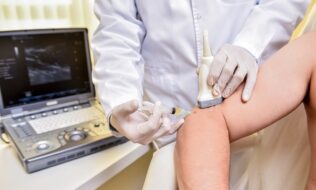
Ultrasound guided injection pain relief
Introduction
Ultrasound-guided injections provide targeted pain relief for a wide range of musculoskeletal conditions. Using real-time ultrasound imaging, our consultant radiologists inject a combination of local anaesthetic (for immediate pain relief) and corticosteroid (for longer-term anti-inflammatory effect) exactly where needed.
This precision approach is far superior to “blind” injections, with significantly higher success rates and fewer side effects. We treat joint pain (shoulder, knee, hip), tendon problems (tennis elbow, Achilles), bursitis, ganglion cysts, and nerve entrapments (carpal tunnel syndrome).
The procedure takes 15-20 minutes with minimal discomfort. Most patients experience significant pain relief within 48-72 hours. Ideal for those in Brentwood and across Essex seeking effective, minimally invasive pain management.
Types of Injection:
- Corticosteroid (Steroid):
- Powerful anti-inflammatory medication
- Reduces swelling and inflammation
- Provides longer-term relief (weeks to months)
- Common preparations: Triamcinolone, Methylprednisolone, Depo-Medrone
- Local Anaesthetic:
- Immediate numbness
- Confirms accurate placement (diagnostic test)
- Reduces injection discomfort
- Short-acting (hours) or long-acting (days)
- Common: Lidocaine, Bupivacaine
- Combined (Most Common):
- Both steroid + local anaesthetic together
- Immediate relief from anaesthetic
- Longer-term relief from steroid
- Best of both worlds
Conditions We Treat:
Joint Injections:
Shoulder:
- Subacromial bursitis / impingement
- Frozen shoulder (adhesive capsulitis)
- Glenohumeral arthritis
- AC joint (acromioclavicular) arthritis
- Rotator cuff tendinitis
Knee:
- Knee osteoarthritis
- Patellar tendinitis
- Pes anserine bursitis
- Prepatellar bursitis
- Baker’s cyst
Hip:
- Hip osteoarthritis
- Trochanteric bursitis (greater trochanter)
- Iliopsoas bursitis
- Hip flexor tendinopathy
Ankle:
- Ankle arthritis
- Tibialis posterior tendinopathy
- Peroneal tendinopathy
Other Joints:
- Elbow arthritis
- Wrist arthritis
- Thumb base (CMC joint) arthritis
- Small joints (fingers, toes)
Tendon Injections (Peri-Tendinous):
Elbow:
- Tennis elbow (lateral epicondylitis)
- Golfer’s elbow (medial epicondylitis)
Wrist/Hand:
- De Quervain’s tenosynovitis
- Trigger finger/thumb
- Flexor/extensor tendinopathy
Ankle/Foot:
- Achilles tendinopathy (peri-tendinous, NOT into tendon)
- Plantar fasciitis
- Tibialis posterior tendinitis
Shoulder:
- Rotator cuff tendinitis
- Biceps tendinitis
- Calcific tendinitis
Hip:
- Gluteal tendinopathy
- Hip flexor tendinitis
Soft Tissue Conditions:
Bursitis:
- Any inflamed bursa (fluid-filled sac)
- Shoulder (subacromial, subdeltoid)
- Hip (trochanteric, iliopsoas)
- Knee (prepatellar, pes anserine)
- Elbow (olecranon)
Cysts:
- Ganglion cysts (wrist, foot, knee)
- Baker’s cyst (behind knee)
Nerve Entrapments:
- Carpal tunnel syndrome (median nerve at wrist)
- Tarsal tunnel syndrome (tibial nerve at ankle)
- Morton’s neuroma (foot)
- Cubital tunnel syndrome (ulnar nerve at elbow)
Why Ultrasound Guidance is Essential:
Blind Injections (Without Imaging):
❌ 30-70% miss target (depends on joint)
❌ Inject into wrong tissue
❌ Risk of hitting nerves/vessels
❌ Waste medication
❌ Lower success rates
❌ Higher complication risk
Ultrasound-Guided Injections:
✅ 95-99% accuracy
✅ See needle and target in real-time
✅ Visualize anatomical structures (nerves, vessels)
✅ Avoid vital structures
✅ Confirm medication placement
✅ Use minimal effective dose
✅ Significantly better outcomes
✅ Safer procedure
The Injection Procedure:
Step 1: Ultrasound Assessment (5 mins)
- Examine area with ultrasound
- Identify pathology
- Confirm diagnosis
- Plan needle approach
- Mark skin if needed
Step 2: Preparation (2 mins)
- Position comfortably
- Clean skin with antiseptic
- Sterile gel applied
- Explain what to expect
Step 3: Injection (5-10 mins)
- Needle inserted under ultrasound guidance
- Real-time visualization of needle tip
- Advance to target tissue
- Inject medication slowly
- Watch medication spread in target area
- Withdraw needle
Step 4: Post-Injection (2 mins)
- Apply pressure
- Small dressing
- Immediate advice given
- Can leave immediately
Total time: 15-20 minutes
What to Expect – Timeline:
During Injection:
- Brief sharp scratch (needle)
- Pressure sensation as medication injected
- Generally well-tolerated
- Some areas more sensitive (plantar fascia)
Hours 1-4:
- Local anaesthetic working
- Pain relief almost immediate
- Area may feel numb
- Enjoy this relief!
Day 1-2:
- Anaesthetic wears off
- Pain may return temporarily
- Sometimes WORSE than before (normal!)
- “Post-injection flare” (20% of patients)
- Ice and paracetamol help
Day 3-7:
- Steroid starts working
- Improvement usually begins
- Pain decreasing
- Function improving
Week 1-4:
- Progressive improvement
- Maximum benefit often week 2-3
- Pain significantly reduced
- Can increase activities
Duration of Relief:
- Bursitis: 3-6 months (often cured)
- Tendinitis: 6-12 weeks to 6 months
- Arthritis: 3-6 months (varies widely)
- Nerve entrapment: Variable (may need repeat)
- Trigger finger: Often permanent after 1-2 injections
How Many Injections?
- Most patients: 1 injection sufficient
- Some conditions: 2-3 injections (spaced 6+ weeks apart)
- Maximum: 3-4 injections per year per joint (general guideline)
- Can alternate sites
- Repeat when relief wears off
Success Rates:
| Condition | Success Rate |
| Subacromial bursitis | 70-90% |
| Tennis elbow | 70-80% |
| Trigger finger | 60-90% |
| Carpal tunnel | 50-70% |
| Plantar fasciitis | 70-80% |
| Knee arthritis | 50-70% |
| Trochanteric bursitis | 60-80% |
| De Quervain’s | 70-85% |
Post-Injection Instructions:
First 24 Hours:
- Rest the injected area
- Ice application (15 mins, 3-4x daily)
- Avoid strenuous activity
- Paracetamol for discomfort (NOT ibuprofen)
- Expect possible pain increase (flare)
Days 2-7:
- Gentle movement okay
- Gradually increase activity
- Continue ice if needed
- Avoid sports/heavy lifting
- Listen to your body
After 1 Week:
- Return to normal activities
- Resume sports as tolerated
- Continue physiotherapy
- Strengthen muscles
What NOT to Do:
- ❌ Vigorous activity for 48 hours
- ❌ Swimming for 24 hours
- ❌ Hot bath/sauna for 24 hours
- ❌ Massage area for 1 week
Side Effects:
Common (Not Serious):
- Post-injection pain flare (20%) – worse for 1-2 days
- Skin dimpling/colour change at injection site (temporary)
- Facial flushing (warmth, redness) – hours to days, harmless
- Temporary increase in blood sugar (diabetics) – monitor levels
Rare:
- Infection (<1 in 10,000) – increasing pain, fever, redness
- Tendon rupture (if injected into tendon – we avoid this!)
- Fat atrophy (skin depression) – mainly cosmetic
- Skin depigmentation (lighter skin patch) – may be permanent
- Allergic reaction (very rare)
Warning Signs – Seek Immediate Help:
- Severe, worsening pain
- Hot, red, swollen area
- Fever or chills
- Spreading redness (These suggest infection – call us immediately)
Special Considerations:
Diabetics:
- Blood sugar may rise for 2-3 days
- Monitor levels more frequently
- Adjust insulin if needed
- Inform your diabetes team
Anticoagulants (Blood Thinners):
- Aspirin: Usually continue
- Warfarin: Check INR, usually okay if <3
- DOACs: Often continue
- Discuss with your doctor
Pregnancy:
- Generally avoided
- Weigh risks vs benefits
- Certain areas safer than others
Infection:
- Not given if infection present
- Skin or joint infection = contraindication
Who is NOT Suitable:
Absolute Contraindications:
- Active infection at injection site
- Active systemic infection
- Known allergy to medication
- Unwilling patient
Relative Contraindications:
- Poorly controlled diabetes
- Immunosuppressed
- Multiple previous failed injections
- Complete tendon tear (needs surgery)
Combining Treatments:
- Steroid injection for quick relief
- Physiotherapy for long-term strength
- PRP for tissue healing
- Sequential approach often best
Our Expertise:
- Consultant radiologists
- Specialized MSK training
- High-volume practice
- Evidence-based protocols
- Patient-centered care